

-
1 MOS Code
Military: MOSC -
2 mos
le code pour représentation ( ISO 639-2) de nom de (d'):moréMossiCodes français-anglais pour la représentation des noms de langues ISO 639-1-2 > mos
-
3 кодовое обозначение ВУС
Military: MOS code, military occupational specialty codeУниверсальный русско-английский словарь > кодовое обозначение ВУС
-
4 перечень основных специальностей ЛС бронетанковых войск
Military: armor basic MOS codeУниверсальный русско-английский словарь > перечень основных специальностей ЛС бронетанковых войск
-
5 линейное предсказание с кодовым возбуждением
линейное предсказание с кодовым возбуждением
Алгоритм низкоскоростного сжатия речевого сигнала, основанный на использовании модели его передачи с линейным предсказанием и анализом спектра огибающей, что позволяет определить период основного тона речи. Основные характеристики вокодера CELP: выходная скорость - 1200, 2400, 4800 и 9600 бит/с (стандарт IS-95), 8000 бит/с (ITU-CELP); средняя оценка качество по шкале MOS 3,7 (9600 бит/с) и 3,0 (4800 бит/с); вносимая задержка не более 30 мс.
[Л.М.Невдяев. Мобильная связь 3-го поколения. Москва, 2000 г.]Тематики
EN
Русско-английский словарь нормативно-технической терминологии > линейное предсказание с кодовым возбуждением
-
6 νόμος
νόμος, ου, ὁ (νέμω; [Zenodotus reads ν. in Od. 1, 3] Hes.+; loanw. in rabb.—On the history of the word MPohlenz, Nomos: Philol 97, ’48, 135–42; GShipp, Nomos ‘Law’ ’78; MOstwald, Nomos and the Beginnings of Athenian Democracy ’69). The primary mng. relates to that which is conceived as standard or generally recognized rules of civilized conduct esp. as sanctioned by tradition (Pind., Fgm. 152, 1=169 Schr. νόμος ὁ πάντων βασιλεύς; cp. SEG XVII, 755, 16: Domitian is concerned about oppressive practices hardening into ‘custom’; MGigante, ΝΟΜΟΣ ΒΑΣΙΛΕΥΣ [Richerche filologiche 1] ’56). The synonym ἔθος (cp. συνήθεια) denotes that which is habitual or customary, especially in reference to personal behavior. In addition to rules that take hold through tradition, the state or other legislating body may enact ordinances that are recognized by all concerned and in turn become legal tradition. A special semantic problem for modern readers encountering the term ν. is the general tendency to confine the usage of the term ‘law’ to codified statutes. Such limitation has led to much fruitless debate in the history of NT interpretation.—HRemus, Sciences Religieuses/Studies in Religion 13, ’84, 5–18; ASegal, Torah and Nomos in Recent Scholarly Discussion, ibid., 19–27.① a procedure or practice that has taken hold, a custom, rule, principle, norm (Alcman [VII B.C.], Fgm. 93 D2 of the tune that the bird sings; Ocellus [II B.C.] c. 49 Harder [1926] τῆς φύσεως νόμος; Appian, Basil. 1 §2 πολέμου ν., Bell. Civ. 5, 44 §186 ἐκ τοῦδε τοῦ σοῦ νόμου=under this rule of yours that governs action; Polyaenus 5, 5, 3 ν. πόμπης; 7, 11, 6 ν. φιλίας; Sextus 123 τοῦ βίου νόμος; Just., A II, 2, 4 παρὰ τὸν τῆς φύσεως ν.; Ath. 3, 1 νόμῳ φύσεως; 13, 1 θυσιῶν νόμῳ)ⓐ gener. κατὰ νόμον ἐντολῆς σαρκίνης in accordance w. the rule of an external commandment Hb 7:16. εὑρίσκω τὸν νόμον I observe an established procedure or principle or system Ro 7:21 (ν. as ‘principle’, i.e. an unwritten rightness of things Soph., Ant. 908). According to Bauer, Paul uses the expression νόμος (which dominates this context) in cases in which he prob. would have preferred another word. But it is also prob. that Paul purposely engages in wordplay to heighten the predicament of those who do not rely on the gospel of liberation from legal constraint: the Apostle speaks of a principle that obligates one to observe a code of conduct that any sensible pers. would recognize as sound and valid ὁ νόμος τ. νοός μου vs. 23b (s. νοῦς 1a). Engaged in a bitter struggle w. this νόμος there is a ἕτερος νόμος which, in contrast to the νοῦς, dwells ἐν τοῖς μέλεσίν μου in my (physical) members vs. 23a, and hence is a νόμος τῆς ἁμαρτίας vs. 23c and 25b or a νόμος τ. ἁμαρτίας καὶ τ. θανάτου 8:2b. This sense prepares the way for the specific perspectiveⓑ of life under the lordship of Jesus Christ as a ‘new law’ or ‘system’ of conduct that constitutes an unwritten tradition ὁ καινὸς ν. τοῦ κυρίου ἡμῶν Ἰησοῦ Χριστοῦ 2:6; in brief ν. Ἰησοῦ Χριστοῦ IMg 2 (cp. Just., D. 11, 4; 43, 1; Mel., P. 7, 46). Beginnings of this terminology as early as Paul: ὁ ν. τοῦ Χριστοῦ =the standard set by Christ Gal 6:2 (as vs. 3 intimates, Christ permitted himself to be reduced to nothing, thereby setting the standard for not thinking oneself to be someth.). The gospel is a νόμος πίστεως a law or system requiring faith Ro 3:27b (FGerhard, TZ 10, ’54, 401–17) or ὁ ν. τοῦ πνεύματος τῆς ζωῆς ἐν Χρ. Ἰ. the law of the spirit (=the spirit-code) of life in Chr. J. 8:2a. In the same sense Js speaks of a ν. βασιλικός (s. βασιλικός) 2:8 or ν. ἐλευθερίας vs. 12 (λόγος ἐλ. P74), ν. τέλειος ὁ τῆς ἐλευθερίας 1:25 (association w. 1QS 10:6, 8, 11 made by EStauffer, TLZ 77, ’52, 527–32, is rejected by SNötscher, Biblica 34, ’53, 193f. On the theme of spontaneous moral achievement cp. Pind., Fgm. 152 [169 Schr.] 1f νόμος ὁ πάντων βασιλεὺς | θνατῶν τε καὶ ἀθανάτων | ἄγει δικαιῶν τὸ βιαιότατον| ὑπερτάτᾳ χειρί=custom is lord of all, of mortals and immortals both, and with strong hand directs the utmost power of the just. Plut., Mor. 780c interprets Pindar’s use of νόμος: ‘not written externally in books or on some wooden tablets, but as lively reason functioning within him’ ἔμψυχος ὢν ἐν αὐτῷ λόγῳ; Aristot., EN 4, 8, 10 οἷον ν. ὢν ἑαυτῷ; Diod S 1, 94, 1 ν. ἔγγραπτος; cp. also Ovid, Met. 1, 90 sponte sua sine lege fidem rectumque colebat; Mayor, comm. ‘Notes’ 73.—RHirzel, ΑΓΡΑΦΟΣ ΝΟΜΟΣ 1903.). Some would put ὁ νόμος Js 2:9 here (s. LAllevi, Scuola Cattol. 67, ’39, 529–42), but s. 2b below.—Hermas too, who in part interprets Israel’s legal tradition as referring to Christians, sees the gospel, exhibited in Christ’s life and words, as the ultimate expression of God’s will or ‘law’. He says of Christ δοὺς αὐτοῖς (i.e. the believers) τὸν ν., ὅν ἔλαβε παρὰ τοῦ πατρὸς αὐτοῦ Hs 5, 6, 3, cp. Hs 8, 3, 3. Or he sees in the υἱὸς θεοῦ κηρυχθεὶς εἰς τὰ πέρατα τῆς γῆς, i.e. the preaching about the Son of God to the ends of the earth, the νόμος θεοῦ ὁ δοθεὶς εἰς ὅλον. τ. κόσμον 8, 3, 2. Similarly to be understood are τηρεῖν τὸν ν. 8, 3, 4. ὑπὲρ τοῦ ν. παθεῖν 8, 3, 6. ὑπὲρ τοῦ ν. θλίβεσθαι 8, 3, 7. ἀρνησάμενοι τὸν νόμον ibid. βλασφημεῖν τὸν ν. 8, 6, 2.② constitutional or statutory legal system, lawⓐ gener.: by what kind of law? Ro 3:27. ν. τῆς πόλεως the law of the city enforced by the ruler of the city (ν. ἐν ταῖς πόλεσι γραπτός Orig., C. Cels. 5, 37, 2); the penalty for breaking it is banishment Hs 1:5f. τοῖς ν. χρῆσθαι observe the laws 1:3; πείθεσθαι τοῖς ὡρισμένοις ν. obey the established laws Dg 5:10; νικᾶν τοὺς ν. ibid. (νικάω 3). Ro 7:1f, as well as the gnomic saying Ro 4:15b and 5:13b, have been thought by some (e.g. BWeiss, Jülicher) to refer to Roman law, but more likely the Mosaic law is meant (s. 3 below).ⓑ specifically: of the law that Moses received from God and is the standard according to which membership in the people of Israel is determined (Diod S 1, 94, 1; 2: the lawgiver Mneves receives the law from Hermes, Minos from Zeus, Lycurgus from Apollo, Zarathustra from the ἀγαθὸς δαίμων, Zalmoxis from Hestia; παρὰ δὲ τοῖς Ἰουδαίοις, Μωϋσῆς receives the law from the Ἰαὼ ἐπικαλούμενος θεός) ὁ ν. Μωϋσέως Lk 2:22; J 7:23; Ac 15:5. ν. Μωϋσέως Ac 13:38; Hb 10:28. Also ὁ ν. κυρίου Lk 2:23f, 39; GJs 14:1. ὁ ν. τοῦ θεοῦ (Theoph. Ant. 2, 14 [p. 136, 4]) Mt 15:6 v.l.; Ro 8:7 (cp. Tat. 7, 2; 32, 1; Ath. 3:2). ὁ ν. ἡμῶν, ὑμῶν, αὐτῶν etc. J 18:31; 19:7b v.l.; Ac 25:8. κατὰ τὸν ἡμέτερον ν. 24:6 v.l. (cp. Jos., Ant. 7, 131). ὁ πατρῷος ν. 22:3. τὸν ν. τῶν ἐντολῶν Eph 2:15. Since the context of Ac 23:29 ἐγκαλούμενον περὶ ζητημάτων τοῦ νόμου αὐτῶν points to the intimate connection between belief, cult, and communal solidarity in Judean tradition, the term νόμος is best rendered with an hendiadys: (charged in matters) relating to their belief and custom; cp. ν. ὁ καθʼ ὑμᾶς 18:15. Ro 9:31 (CRhyne, Νόμος Δικαιοσύνης and the meaning of Ro 10:4: CBQ 47, ’85, 486–99).—Abs., without further qualification ὁ ν. Mt 22:36; 23:23; Lk 2:27; J 1:17; Ac 6:13; 7:53; 21:20, 28; Ro 2:15 (τὸ ἔργον τοῦ νόμου the work of the law [=the moral product that the Mosaic code requires] is written in the heart; difft. Diod S 1, 94, 1 ν. ἔγγραπτος, s. 1b, above), 18, 20, 23b, 26; 4:15a, 16; 7:1b, 4–7, 12, 14, 16; 8:3f; 1 Cor 15:56; Gal 3:12f, 17, 19, 21a, 24; 5:3, 14; 1 Ti 1:8 (GRudberg, ConNeot 7, ’42, 15); Hb 7:19 (s. Windisch, Hdb. exc. ad loc.), 28a; 10:1; cp. Js 2:9 (s. 1b above); μετὰ τὸν ν. Hb 7:28b; οἱ ἐν τῷ ν. Ro 3:19; κατὰ τὸν ν. according to the (Mosaic) law (Jos., Ant. 14, 173; 15, 51 al.; Just., D. 10, 1) J 19:7b; Ac 22:12; 23:3; Hb 7:5; 9:22. παρὰ τ. νόμον contrary to the law (Jos., Ant. 17, 151, C. Ap. 2, 219; Ath. 1, 3 παρὰ πάντα ν.) Ac 18:13.—νόμος without the art. in the same sense (on the attempt, beginning w. Origen, In Ep. ad Ro 3:7 ed. Lomm. VI 201, to establish a difference in mng. betw. Paul’s use of ὁ νόμος and νόμος s. B-D-F §258, 2; Rob. 796; Mlt-Turner 177; Grafe [s. 3b below] 7–11) Ro 2:13ab, 17, 23a, * 25a; 3:31ab; 5:13, 20; 7:1a (s. above); Gal 2:19b; 5:23 (JRobb, ET 56, ’45, 279f compares κατὰ δὲ τῶν τοιούτων οὐκ ἔστι νόμος Aristot., Pol. 1284a). δικαίῳ νόμος οὐ κεῖται, ἀνόμοις δὲ … 1 Ti 1:9. Cp. ἑαυτοῖς εἰσιν νόμος Ro 2:14 (in Pla., Pol. and in Stoic thought the wise person needed no commandment [Stoic. III 519], the bad one did; MPohlenz, Stoa ’48/49 I 133; II 75). Used w. prepositions: ἐκ ν. Ro 4:14; Gal 3:18, 21c (v.l. ἐν ν.); Phil 3:9 (ἐκ νόμου can also mean corresponding to or in conformity with the law: PRev 15, 11 ἐκ τῶν νόμων); cp. ἐκ τοῦ νόμου Ro 10:5. διὰ νόμου Ro 2:12b; 3:20b; 4:13; 7:7b; Gal 2:19a, 21; ἐν ν. (ἐν τῷ ν. Iren. 3, 11, 8 [Harv. II 49, 9]) Ro 2:12a, 23; Gal 3:11, 21c v.l.; 5:4; Phil 3:6. κατὰ νόμον 3:5; Hb 8:4; 10:8 (make an offering κατὰ νόμον as Arrian, Anab. 2, 26, 4; 5, 8, 2); χωρὶς ν. Ro 3:21a; 7:8f; ἄχρι ν. 5:13a. ὑπὸ νόμον 6:14f; 1 Cor 9:20; Gal 3:23; 4:4f, 21a; 5:18 (cp. Just., D. 45, 3 οἱ ὑπὸ τὸν ν.).—Dependent on an anarthrous noun παραβάτης νόμου a law-breaker Ro 2:25b ( 27b w. art.); Js 2:11. ποιητὴς ν. one who keeps the law 4:11d (w. art. Ro 2:13b). τέλος ν. the end of the law Ro 10:4 (RBultmann and HSchlier, Christus des Ges. Ende ’40). πλήρωμα ν. fulfilment of the law 13:10. ν. μετάθεσις a change in the law Hb 7:12. ἔργα ν. Ro 3:20a, 28; 9:32 v.l.; Gal 2:16; 3:2, 5, 10a.—(ὁ) ν. (τοῦ) θεοῦ Ro 7:22, 25a; 8:7 because it was given by God and accords w. his will. Lasting Mt 5:18; Lk 16:17 (cp. Bar 4:1; PsSol 10:4; Philo, Mos. 2, 14; Jos., C. Ap. 2, 277).—Used w. verbs, w. or without the art.: ν. ἔχειν J 19:7a; Ro 2:14 (ApcSed 14:5). πληροῦν ν. fulfill the law Ro 13:8; pass. Gal 5:14 (Mel., P. 42, 291). πληροῦν τὸ δικαίωμα τοῦ ν. fulfill the requirement of the law Ro 8:4. φυλάσσειν τὸν ν. observe the law Ac 21:24; Gal 6:13. τὰ δικαιώματα τοῦ ν. φυλάσσειν observe the precepts of the law Ro 2:26; διώκειν ν. δικαιοσύνης 9:31a; πράσσειν ν. 2:25a. ποιεῖν τὸν ν. J 7:19b; Gal 5:3; Ro 2:14b, s. below; τὸν ν. τηρεῖν Js 2:10. τὸν ν. τελεῖν Ro 2:27. φθάνειν εἰς ν. 9:31b. κατὰ ν. Ἰουδαϊσμὸν ζῆν IMg 8:1 v.l. is prob. a textual error (Pearson, Lghtf., Funk, Bihlmeyer, Hilgenfeld; Zahn, Ign. v. Ant. 1873 p. 354, 1 [difft. in Zahn’s edition] all omit νόμον as a gloss and are supported by the Latin versions; s. Hdb. ad loc.). τὰ τοῦ ν. ποιεῖν carry out the requirements of the law Ro 2:14b (ApcSed 14:5; FFlückiger, TZ 8, ’52, 17–42). καταλαλεῖν νόμου, κρίνειν ν. Js 4:11abc. ἐδόθη ν. Gal 3:21a.—Pl. διδοὺς νόμους μου εἰς τὴν διάνοιαν αὐτῶν Hb 8:10; cp. 10:16 (both Jer 38:33).—Of an individual stipulation of the law ὁ νόμος τοῦ ἀνδρός the law insofar as it concerns the husband (Aristot., Fgm. 184 R. νόμοι ἀνδρὸς καὶ γαμετῆς.—SIG 1198, 14 κατὰ τὸν νόμον τῶν ἐρανιστῶν; Num 9:12 ὁ ν. τοῦ πάσχα; Philo, Sobr. 49 ὁ ν. τῆς λέπρας) Ro 7:2b; cp. 7:3 and δέδεται νόμῳ vs. 2a (on the imagery Straub 94f); 1 Cor 7:39 v.l.—The law is personified, as it were (Demosth. 43, 59; Aeschin. 1, 18; Herm. Wr. 12, 4 [the law of punishment]; IMagnMai 92a, 11 ὁ ν. συντάσσει; b, 16 ὁ ν. ἀγορεύει; Jos., Ant. 3, 274) J 7:51; Ro 3:19.③ a collection of holy writings precious to God’s people, sacred ordinanceⓐ in the strict sense the law=the Pentateuch, the work of Moses the lawgiver (Diod S 40, 3, 6 προσγέγραπται τοῖς νόμοις ἐπὶ τελευτῆς ὅτι Μωσῆς ἀκούσας τοῦ θεοῦ τάδε λέγει τ. Ἰουδαίοις=at the end of the laws this is appended: this is what Moses heard from God and is telling to the Jews. ὁ διὰ τοῦ ν. μεταξὺ καθαρῶν καὶ ἀκαθάρτων διαστείλας θεός Iren. 3, 12, 7 [Harv. II 60, 3]; cp. Hippol., Ref. 7, 34, 1) τὸ βιβλίον τοῦ νόμου Gal 3:10b (cp. Dt 27:26). Also simply ὁ νόμος (Jos., Bell. 7, 162 ὁ ν. or 2, 229 ὁ ἱερὸς ν. of the holy book in a concrete sense) Mt 12:5 (Num 28:9f is meant); J 8:5; 1 Cor 9:8 (cp. Dt 25:4); 14:34 (cp. Gen 3:16); Gal 4:21b (the story of Abraham); Hb 9:19. ὁ ν. ὁ ὑμέτερος J 8:17 (cp. Jos., Bell. 5, 402; Tat. 40, 1 κατὰ τοὺς ἡμετέρους ν.). ἐν Μωϋσέως νόμῳ γέγραπται 1 Cor 9:9. καθὼς γέγραπται ἐν νόμῳ κυρίου Lk 2:23 (γέγραπται ἐν νόμῳ as Athen. 6, 27, 23c; IMagnMai 52, 35 [III B.C.]; Mel., P. 11, 71; cp. Just., D. 8, 4 τὰ ἐν τῷ ν. γεγραμμένα); cp. vs. 24. ἔγραψεν Μωϋσῆς ἐν τῷ νόμῳ J 1:45 (cp. Cercidas [III B.C.], Fgm. 1, 18f Diehl2 [=Coll. Alex. p. 204, 29=Knox p. 196] καὶ τοῦθʼ Ὅμηρος εἶπεν ἐν Ἰλιάδι).—The Sacred Scriptures (OT) referred to as a whole in the phrase ὁ ν. καὶ οἱ προφῆται (Orig., C. Cels. 2, 6, 4; cp. Hippol., Ref. 8, 19, 1) the law (הַתּוֹרָה) and the prophets (הַנְּבִיאִים) Mt 5:17; 7:12; 11:13; 22:40; Lk 16:16; Ac 13:15; 24:14; 28:23; Ro 3:21b; cp. Dg 11:6; J 1:45. τὰ γεγραμμένα ἐν τῷ ν. Μωϋσέως καὶ τοῖς προφήταις καὶ ψαλμοῖς Lk 24:44.ⓑ In a wider sense=Holy Scripture gener., on the principle that the most authoritative part gives its name to the whole (ὁ ν. ὁ τοῦ θεοῦ Theoph. Ant. 1, 11 [p. 82, 15]): J 10:34 (Ps 81:6); 12:34 (Ps 109:4; Is 9:6; Da 7:14); 15:25 (Ps 34:19; 68:5); 1 Cor 14:21 (Is 28:11f); Ro 3:19 (preceded by a cluster of quotations fr. Psalms and prophets).—Mt 5:18; Lk 10:26; 16:17; J 7:49.—JHänel, Der Schriftbegriff Jesu 1919; OMichel, Pls u. s. Bibel 1929; SWesterholm, Studies in Religion 15, ’86, 327–36.—JMeinhold, Jesus u. das AT 1896; MKähler, Jesus u. das AT2 1896; AKlöpper, Z. Stellung Jesu gegenüber d. Mos. Gesetz, Mt 5:17–48: ZWT 39, 1896, 1–23; EKlostermann, Jesu Stellung z. AT 1904; AvHarnack, Hat Jesus das atl. Gesetz abgeschafft?: Aus Wissenschaft u. Leben II 1911, 225–36, SBBerlAk 1912, 184–207; KBenz, D. Stellung Jesu zum atl. Gesetz 1914; MGoguel, RHPR 7, 1927, 160ff; BBacon, Jesus and the Law: JBL 47, 1928, 203–31; BBranscomb, Jes. and the Law of Moses 1930; WKümmel, Jes. u. d. jüd. Traditionsged.: ZNW 33, ’34, 105–30; JHempel, D. synopt. Jesus u. d. AT: ZAW 56, ’38, 1–34.—Lk-Ac: JJervell, HTR 64, ’71, 21–36.—EGrafe, D. paulin. Lehre vom Gesetz2 1893; HCremer, D. paulin. Rechtfertigungslehre 1896, 84ff; 363ff; FSieffert, D. Entwicklungslinie d. paul. Gesetzeslehre: BWeiss Festschr. 1897, 332–57; WSlaten, The Qualitative Use of νόμος in the Pauline Ep.: AJT 23, 1919, 213ff; HMosbech, Pls’ Laere om Loven: TT 4/3, 1922, 108–37; 177–221; EBurton, ICC, Gal 1921, 443–60; PFeine, Theol. des NT6 ’34, 208–15 (lit.); PBenoit, La Loi et la Croix d’après S. Paul (Ro 7:7–8:4): RB 47, ’38, 481–509; CMaurer, D. Gesetzeslehre des Pls ’41; PBläser, D. Gesetz b. Pls ’41; BReicke, JBL 70, ’51, 259–76; GBornkamm, Das Ende d. Gesetzes ’63; HRaisänen, Paul and the Law2 ’87; PRichardson/SWesterholm, et al., Law in Religious Communities in the Rom. Period, ’91 (Torah and Nomos); MNobile, La Torà al tempo di Paolo, alcune ri-flessioni: Atti del IV simposio di Tarso su S. Paolo Apostolo, ed. LPadovese ’96, 93–106 (lit. 93f, n. 1).—Dodd 25–41.—B. 1358; 1419; 1421. DELG s.v. νέμω Ic. Schmidt, Syn. I 333–47. M-M. EDNT. TW. Sv. -
7 moré
Codes français-anglais pour la représentation des noms de langues ISO 639-1-2 > moré
-
8 адаптивная дифференциальная импульсно-кодовая модуляция
адаптивная дифференциальная импульсно-кодовая модуляция
Стандартизованная ITU методика кодирования аналогового сигнала (речь) в цифровую форму с полосой 32 Кбит/сек (половина стандартной полосы PCM). Этот алгоритм кодирует разницу между амплитудой реального сигнала и предсказанной амплитудой и адаптирует разрешение на базе последней разности. Часть протокола канального уровня в сети AppleTalk.
[ http://www.lexikon.ru/dict/net/index.html]
адаптивная дифференциальная импульсно-кодовая модуляция
Метод аналого-цифрового преобразования, при котором по каналу связи передается не абсолютное значение амплитуды квантованного сигнала, а разность между его текущим и предыдущим значениями. При частоте дискретизации 8 кбит/с и четырехбитовом кодовом слове (три бита для амплитуды и один для знака) выходная скорость равна 32 кбит/с (G.726). Наиболее простой способ реализации данного метода сжатия речи основан на адаптивном алгоритме преобразования PCM/ADPCM со снижением скорости передачи в два раза (рис. А-4). Декодер ADPCM обеспечивает воспроизведение речи с качеством, близким к РСМ (оценка 4,1 по шкале MOS). Данный метод модуляции применяется в ряде стандартов беспроводного доступа (СТ2, DECT, PHS, PACS).
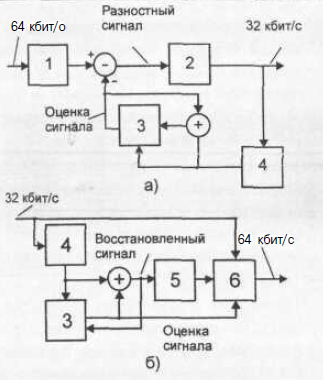
Рис. А-4. Структурная схема кодека ADPCM: а - кодер; 6 - декодер; 1 - блок преобразования сигнала РСМ с А - или μ-законом сжатия в сигнал с равномерным законом квантования; 2 - адаптивный квантователь; 3 - адаптивный предсказатель; 4 - инверсный адаптивный квантователь; 5 - блок преобразования в РСМ сигнал с А - или μ-законом командирования; б – подстройка синхронного кодирования
[Л.М. Невдяев. Телекоммуникационные технологии. Англо-русский толковый словарь-справочник. Под редакцией Ю.М. Горностаева. Москва, 2002]Тематики
EN
Русско-английский словарь нормативно-технической терминологии > адаптивная дифференциальная импульсно-кодовая модуляция
-
9 алгебраическое линейное предсказание с кодовым возбуждением и сопряженной структурой
алгебраическое линейное предсказание с кодовым возбуждением и сопряженной структурой
Усовершенствованный алгоритм речевого кодирования с линейным предсказанием, в котором используются две кодовых книги, одна из которых является фиксированной, а вторая - адаптивной. Использование двух книг позволяет повысить качество распознавания речи при большом уровне шума. Основные характеристики кодера CS-ACELP (G.729): выходная скорость – 8 кбит/с, оценка качества 3,85 (по шкале MOS), вносимая задержка - до 25 мс.
[Л.М. Невдяев. Телекоммуникационные технологии. Англо-русский толковый словарь-справочник. Под редакцией Ю.М. Горностаева. Москва, 2002]Тематики
- электросвязь, основные понятия
EN
Русско-английский словарь нормативно-технической терминологии > алгебраическое линейное предсказание с кодовым возбуждением и сопряженной структурой
-
10 cīvīlis
cīvīlis e, adj. with comp. [civis], of citizens, civil, civic: bellum: discordia, S.: acies, O.: aestus, H.: victoria, N.: mos consuetudoque: clamor, L.: quercus (i. e. corona civica), V.—As subst n.: si quicquam in vobis civilis esset, sense of public duty, L.—In the phrase ius civile, private rights, the law (as protecting citizens): sit ergo in iure civili finis hic: neque naturali neque civili iure descripto: de iure civili si quis novi quid instituit, the Civil Law: quod agas mecum ex iure civili non habes: civile ius evolgavit, a code of procedure, L.: inteream si... novi civilia iura, legal process, H.—Meton., of the state, relating to public life, political, public, state: scientia, political science: mersor civilibus undis, H.— Civil (opp. military): officia: munera, L.: res, L. — Fig., courteous, polite, civil, affable, urbane: quid enim civilius illo? O.: sermo minime, L.: ingenium, Ta.: parum civile, unbecoming a private citizen, L.* * *civilis, civile ADJof/affecting fellow citizens; civil; legal; public; political; unassuming -
11 civile
1.cīvīlis, e, adj. [civis].I.Of or pertaining to citizens, civil, civic (class. in prose and poetry, and very freq.): sanguine civili rem conflant, by the blood of citizens, * Lucr. 3, 70; Cic. Fam. 15, 15, 1:2.conjuratio,
id. ib. 5, 12, 2:bellum,
id. Att. 7, 13, 1; id. Imp. Pomp. 10, 28:bella,
Hor. Epod. 16, 1; Luc. 1, 1:genus belli,
Cic. Att. 7, 13, 1; Sall. C. 47, 2; Quint. 12, 1, 16; Flor. 3, 22, 10; 3, 23, 7:facinus,
Cic. Att. 7, 13, 1.—So De Bello Civili, the title of a portion of the Commentaries of Julius Cæsar, Flor. 4, 2, 4:discordia,
Sall. C. 5, 2:dissensio,
id. J. 41 fin.:discidii specie,
Tac. A. 14, 60:irae,
id. ib. 1, 43:acies,
Ov. M. 7, 142:arma,
civil war, Cic. Div. 2, 2, 6; Tac. A. 1, 9:aestus,
Hor. Ep. 2, 2, 47:Mars,
Ov. H. 6, 35:busta,
Prop. 2, 1, 27:victoria,
Nep. Epam. 10, 3; Sall. J. 95, 4; Tac. H. 4, 38 fin.:praeda,
id. ib. 3, 15 et saep.:mos consuetudoque,
Cic. Off. 1, 41,148; cf.just before: instituta civilia: conciliatio et societas,
id. N. D. 2, 31, 78:facinus,
id. Att. 7, 13, 1:clamor,
Liv. 3, 28, 4; cf.robur,
id. 28, 44, 5:curae,
Hor. C. 3, 8, 17:quercus = corona civica (v. civicus, I.),
Verg. A. 6, 772: civilis dies, the civil day ( from midnight to midnight; opp. to the naturalis dies, from the rising to the setting of the sun), Varr. R. R. 1, 28, 1; Plin. 2, 77, 79, § 188; Macr. S. 1, 3:amor (opp. to naturalis),
between citizens, Gell. 12, 1, 23.—Esp.: jus civile.a.In gen., private rights, the law, as it protects citizens in their status, property, etc.:b.jus civile est aequitas constituta iis, qui ejusdem civitatis sunt, ad res suas obtinendas,
Cic. Top. 2, 9:sit ergo in jure civili finis hic: legitimae atque usitatae in rebus causisque civium aequabilitatis conservatio,
id. de Or. 1, 42, 188:qui jus civile contemnendum putat, is vincula revellit judiciorum, etc.,
id. Caecin. 25, 70; id. Off. 3, 17, 69; id. Balb. 11, 28; Gai Inst. 1, 1; Just. Inst. 1, 2, 1 sq.;opp. jus naturale: quodam tempore homines nondum neque naturali neque civili jure descripto fusi, etc.,
Cic. Sest. 42, 91.—The body of Roman law relating to private rights, the Civil Law:c.ut si quis dicat jus civile id esse, quod in legibus, senatūs consultis, rebus judicatis, juris peritorum auctoritate, edictis magistratuum, more, aequitate consistat,
Cic. Top. 5, 28:hoc civile (jus) quod dicimus (opp. causa universi juris ac legum),
id. Leg. 1, 5, 17:de jure civili si quis novi quid instituit,
id. Verr. 2, 1, 42, § 109;opp. jus nationum,
id. Div in Caecil. 5, 18;opp. jus praetorium, the precedents of decisions by the prætor: nam quod agas mecum ex jure civili ac praetorio non habes,
id. Caecin. 12, 34; 2, 4; cf. Dig. 1, 1, 7 pr. and § 1.—In narrower sense, the code of procedure, the forms of process in the Roman law:B.civile jus, repositum in penetralibus pontificum, evulgavit (Licinius),
Liv. 9, 46, 5 Weissenb. ad loc.:jus civile per multa saecula inter sacra caerimoniasque deorum abditum, Cn. Flavius vulgavit,
Val. Max. 2, 5, 2; cf. Dig. 1, 2, 2, § 5 sqq.; plur.:inteream si... novi civilia jura,
Hor. S. 1, 9, 39.—Relating to public or political life, political, public, state-:2.scientia,
politics, political science, Cic. Inv. 1, 5, 6; Quint. 2, 15, 33:quaestiones,
id. 2, 15, 36:officia,
id. 2, 15, 36, and 2, 4, 27:civilium rerum peritus,
Tac. H. 2, 5:mersor civilibus undis,
Hor. Ep. 1, 1, 16: vir, a statesman, politikos, Quint. prooem. § 10; 11, 10, 15; 12, 2, 7; 12, 2, 21; 11, 1, 35.—Esp. civil, opp. military (first in Livy):II.is gravis annis non militaribus solum sed civilibus quoque abscesserat muneribus,
Liv. 9, 3, 5; cf.:civilis res haud magnopere obeuntem bella excitabant,
id. 6, 22, 7.—Trop. (cf. popularis, and the Gr. koinos), demeaning one ' s self as a citizen; hence of distinguished persons, courteous, polite, civil, affable, urbane (so not before the Aug. per.; esp. freq. in Suet.;1.in Quint. only once): quid enim civilius illo?
Ov. Tr. 4, 4, 13:sermo,
Liv. 6, 40, 15:animus,
id. 45, 32, 5; Tac. A. 1, 72; Suet. Caes. 75; id. Claud. 1; id. Dom. 12; cf. id. Calig. 3; id. Vesp. 12:parumque id non civile modo sed humanum etiam visum,
unbecoming a private citizen, Liv. 5, 23, 5:et humano ingressu,
Quint. 3, 8, 59 Spald.:incessu,
Plin. Pan. 83, 7:civile ingenium, mira comitas,
Tac. A. 1, 33; cf. id. ib. 2, 82: arma, id. H. 4, 3:civile rebatur, misceri voluptatibus vulgi,
id. A. 1, 54; cf. id. ib. 2, 34; 3, 22; Plin. Pan. 78, 4; 87, 1:civilis circa amicos,
Eutr. 7, 13:in cunctos,
id. 10, 16.— Sup., Eutr. 8, 1; Spart. Had. 20, 1.—As subst.: cīvīle, is, n., courtesy:si quicquam in vobis non dico civilis sed humani esset,
Liv. 5, 3, 9.—Hence, adv.: cīvīlĭter.(Acc. to I.) Citizen-like: vivere, Cic. ap. Lact. 3, 14: certare, Cael. ap. Cic. Fam. 8, 14, 3; Liv. 38, 56, 9; 33, 46, 3; Juv. 5, 112; Gell. praef. § 13.—b.In judicial language, civilly (opp. criminally):2.agere,
Dig. 47, 2, 92; 11, 6, 1; 47, 10, 37.—(Acc. to 2.) As becomes a citizen, courteously, kindly, Ov. M. 12, 583; id. Tr. 3, 8, 41; Tac. A. 3, 76; 4, 21; id. H. 2, 91.— Comp.:2.civilius,
Plin. Pan. 29, 2; App. M. 9, p. 236, 10.— Sup.:civilissime,
Eutr. 7, 8.Cīvīlis, is, m., a proper name, e. g. Julius Civilis, chief of the Batavi, Tac. H. 4, 13 sq.; abl. Civile, id. ib. 4, 35. -
12 Civilis
1.cīvīlis, e, adj. [civis].I.Of or pertaining to citizens, civil, civic (class. in prose and poetry, and very freq.): sanguine civili rem conflant, by the blood of citizens, * Lucr. 3, 70; Cic. Fam. 15, 15, 1:2.conjuratio,
id. ib. 5, 12, 2:bellum,
id. Att. 7, 13, 1; id. Imp. Pomp. 10, 28:bella,
Hor. Epod. 16, 1; Luc. 1, 1:genus belli,
Cic. Att. 7, 13, 1; Sall. C. 47, 2; Quint. 12, 1, 16; Flor. 3, 22, 10; 3, 23, 7:facinus,
Cic. Att. 7, 13, 1.—So De Bello Civili, the title of a portion of the Commentaries of Julius Cæsar, Flor. 4, 2, 4:discordia,
Sall. C. 5, 2:dissensio,
id. J. 41 fin.:discidii specie,
Tac. A. 14, 60:irae,
id. ib. 1, 43:acies,
Ov. M. 7, 142:arma,
civil war, Cic. Div. 2, 2, 6; Tac. A. 1, 9:aestus,
Hor. Ep. 2, 2, 47:Mars,
Ov. H. 6, 35:busta,
Prop. 2, 1, 27:victoria,
Nep. Epam. 10, 3; Sall. J. 95, 4; Tac. H. 4, 38 fin.:praeda,
id. ib. 3, 15 et saep.:mos consuetudoque,
Cic. Off. 1, 41,148; cf.just before: instituta civilia: conciliatio et societas,
id. N. D. 2, 31, 78:facinus,
id. Att. 7, 13, 1:clamor,
Liv. 3, 28, 4; cf.robur,
id. 28, 44, 5:curae,
Hor. C. 3, 8, 17:quercus = corona civica (v. civicus, I.),
Verg. A. 6, 772: civilis dies, the civil day ( from midnight to midnight; opp. to the naturalis dies, from the rising to the setting of the sun), Varr. R. R. 1, 28, 1; Plin. 2, 77, 79, § 188; Macr. S. 1, 3:amor (opp. to naturalis),
between citizens, Gell. 12, 1, 23.—Esp.: jus civile.a.In gen., private rights, the law, as it protects citizens in their status, property, etc.:b.jus civile est aequitas constituta iis, qui ejusdem civitatis sunt, ad res suas obtinendas,
Cic. Top. 2, 9:sit ergo in jure civili finis hic: legitimae atque usitatae in rebus causisque civium aequabilitatis conservatio,
id. de Or. 1, 42, 188:qui jus civile contemnendum putat, is vincula revellit judiciorum, etc.,
id. Caecin. 25, 70; id. Off. 3, 17, 69; id. Balb. 11, 28; Gai Inst. 1, 1; Just. Inst. 1, 2, 1 sq.;opp. jus naturale: quodam tempore homines nondum neque naturali neque civili jure descripto fusi, etc.,
Cic. Sest. 42, 91.—The body of Roman law relating to private rights, the Civil Law:c.ut si quis dicat jus civile id esse, quod in legibus, senatūs consultis, rebus judicatis, juris peritorum auctoritate, edictis magistratuum, more, aequitate consistat,
Cic. Top. 5, 28:hoc civile (jus) quod dicimus (opp. causa universi juris ac legum),
id. Leg. 1, 5, 17:de jure civili si quis novi quid instituit,
id. Verr. 2, 1, 42, § 109;opp. jus nationum,
id. Div in Caecil. 5, 18;opp. jus praetorium, the precedents of decisions by the prætor: nam quod agas mecum ex jure civili ac praetorio non habes,
id. Caecin. 12, 34; 2, 4; cf. Dig. 1, 1, 7 pr. and § 1.—In narrower sense, the code of procedure, the forms of process in the Roman law:B.civile jus, repositum in penetralibus pontificum, evulgavit (Licinius),
Liv. 9, 46, 5 Weissenb. ad loc.:jus civile per multa saecula inter sacra caerimoniasque deorum abditum, Cn. Flavius vulgavit,
Val. Max. 2, 5, 2; cf. Dig. 1, 2, 2, § 5 sqq.; plur.:inteream si... novi civilia jura,
Hor. S. 1, 9, 39.—Relating to public or political life, political, public, state-:2.scientia,
politics, political science, Cic. Inv. 1, 5, 6; Quint. 2, 15, 33:quaestiones,
id. 2, 15, 36:officia,
id. 2, 15, 36, and 2, 4, 27:civilium rerum peritus,
Tac. H. 2, 5:mersor civilibus undis,
Hor. Ep. 1, 1, 16: vir, a statesman, politikos, Quint. prooem. § 10; 11, 10, 15; 12, 2, 7; 12, 2, 21; 11, 1, 35.—Esp. civil, opp. military (first in Livy):II.is gravis annis non militaribus solum sed civilibus quoque abscesserat muneribus,
Liv. 9, 3, 5; cf.:civilis res haud magnopere obeuntem bella excitabant,
id. 6, 22, 7.—Trop. (cf. popularis, and the Gr. koinos), demeaning one ' s self as a citizen; hence of distinguished persons, courteous, polite, civil, affable, urbane (so not before the Aug. per.; esp. freq. in Suet.;1.in Quint. only once): quid enim civilius illo?
Ov. Tr. 4, 4, 13:sermo,
Liv. 6, 40, 15:animus,
id. 45, 32, 5; Tac. A. 1, 72; Suet. Caes. 75; id. Claud. 1; id. Dom. 12; cf. id. Calig. 3; id. Vesp. 12:parumque id non civile modo sed humanum etiam visum,
unbecoming a private citizen, Liv. 5, 23, 5:et humano ingressu,
Quint. 3, 8, 59 Spald.:incessu,
Plin. Pan. 83, 7:civile ingenium, mira comitas,
Tac. A. 1, 33; cf. id. ib. 2, 82: arma, id. H. 4, 3:civile rebatur, misceri voluptatibus vulgi,
id. A. 1, 54; cf. id. ib. 2, 34; 3, 22; Plin. Pan. 78, 4; 87, 1:civilis circa amicos,
Eutr. 7, 13:in cunctos,
id. 10, 16.— Sup., Eutr. 8, 1; Spart. Had. 20, 1.—As subst.: cīvīle, is, n., courtesy:si quicquam in vobis non dico civilis sed humani esset,
Liv. 5, 3, 9.—Hence, adv.: cīvīlĭter.(Acc. to I.) Citizen-like: vivere, Cic. ap. Lact. 3, 14: certare, Cael. ap. Cic. Fam. 8, 14, 3; Liv. 38, 56, 9; 33, 46, 3; Juv. 5, 112; Gell. praef. § 13.—b.In judicial language, civilly (opp. criminally):2.agere,
Dig. 47, 2, 92; 11, 6, 1; 47, 10, 37.—(Acc. to 2.) As becomes a citizen, courteously, kindly, Ov. M. 12, 583; id. Tr. 3, 8, 41; Tac. A. 3, 76; 4, 21; id. H. 2, 91.— Comp.:2.civilius,
Plin. Pan. 29, 2; App. M. 9, p. 236, 10.— Sup.:civilissime,
Eutr. 7, 8.Cīvīlis, is, m., a proper name, e. g. Julius Civilis, chief of the Batavi, Tac. H. 4, 13 sq.; abl. Civile, id. ib. 4, 35. -
13 civilis
1.cīvīlis, e, adj. [civis].I.Of or pertaining to citizens, civil, civic (class. in prose and poetry, and very freq.): sanguine civili rem conflant, by the blood of citizens, * Lucr. 3, 70; Cic. Fam. 15, 15, 1:2.conjuratio,
id. ib. 5, 12, 2:bellum,
id. Att. 7, 13, 1; id. Imp. Pomp. 10, 28:bella,
Hor. Epod. 16, 1; Luc. 1, 1:genus belli,
Cic. Att. 7, 13, 1; Sall. C. 47, 2; Quint. 12, 1, 16; Flor. 3, 22, 10; 3, 23, 7:facinus,
Cic. Att. 7, 13, 1.—So De Bello Civili, the title of a portion of the Commentaries of Julius Cæsar, Flor. 4, 2, 4:discordia,
Sall. C. 5, 2:dissensio,
id. J. 41 fin.:discidii specie,
Tac. A. 14, 60:irae,
id. ib. 1, 43:acies,
Ov. M. 7, 142:arma,
civil war, Cic. Div. 2, 2, 6; Tac. A. 1, 9:aestus,
Hor. Ep. 2, 2, 47:Mars,
Ov. H. 6, 35:busta,
Prop. 2, 1, 27:victoria,
Nep. Epam. 10, 3; Sall. J. 95, 4; Tac. H. 4, 38 fin.:praeda,
id. ib. 3, 15 et saep.:mos consuetudoque,
Cic. Off. 1, 41,148; cf.just before: instituta civilia: conciliatio et societas,
id. N. D. 2, 31, 78:facinus,
id. Att. 7, 13, 1:clamor,
Liv. 3, 28, 4; cf.robur,
id. 28, 44, 5:curae,
Hor. C. 3, 8, 17:quercus = corona civica (v. civicus, I.),
Verg. A. 6, 772: civilis dies, the civil day ( from midnight to midnight; opp. to the naturalis dies, from the rising to the setting of the sun), Varr. R. R. 1, 28, 1; Plin. 2, 77, 79, § 188; Macr. S. 1, 3:amor (opp. to naturalis),
between citizens, Gell. 12, 1, 23.—Esp.: jus civile.a.In gen., private rights, the law, as it protects citizens in their status, property, etc.:b.jus civile est aequitas constituta iis, qui ejusdem civitatis sunt, ad res suas obtinendas,
Cic. Top. 2, 9:sit ergo in jure civili finis hic: legitimae atque usitatae in rebus causisque civium aequabilitatis conservatio,
id. de Or. 1, 42, 188:qui jus civile contemnendum putat, is vincula revellit judiciorum, etc.,
id. Caecin. 25, 70; id. Off. 3, 17, 69; id. Balb. 11, 28; Gai Inst. 1, 1; Just. Inst. 1, 2, 1 sq.;opp. jus naturale: quodam tempore homines nondum neque naturali neque civili jure descripto fusi, etc.,
Cic. Sest. 42, 91.—The body of Roman law relating to private rights, the Civil Law:c.ut si quis dicat jus civile id esse, quod in legibus, senatūs consultis, rebus judicatis, juris peritorum auctoritate, edictis magistratuum, more, aequitate consistat,
Cic. Top. 5, 28:hoc civile (jus) quod dicimus (opp. causa universi juris ac legum),
id. Leg. 1, 5, 17:de jure civili si quis novi quid instituit,
id. Verr. 2, 1, 42, § 109;opp. jus nationum,
id. Div in Caecil. 5, 18;opp. jus praetorium, the precedents of decisions by the prætor: nam quod agas mecum ex jure civili ac praetorio non habes,
id. Caecin. 12, 34; 2, 4; cf. Dig. 1, 1, 7 pr. and § 1.—In narrower sense, the code of procedure, the forms of process in the Roman law:B.civile jus, repositum in penetralibus pontificum, evulgavit (Licinius),
Liv. 9, 46, 5 Weissenb. ad loc.:jus civile per multa saecula inter sacra caerimoniasque deorum abditum, Cn. Flavius vulgavit,
Val. Max. 2, 5, 2; cf. Dig. 1, 2, 2, § 5 sqq.; plur.:inteream si... novi civilia jura,
Hor. S. 1, 9, 39.—Relating to public or political life, political, public, state-:2.scientia,
politics, political science, Cic. Inv. 1, 5, 6; Quint. 2, 15, 33:quaestiones,
id. 2, 15, 36:officia,
id. 2, 15, 36, and 2, 4, 27:civilium rerum peritus,
Tac. H. 2, 5:mersor civilibus undis,
Hor. Ep. 1, 1, 16: vir, a statesman, politikos, Quint. prooem. § 10; 11, 10, 15; 12, 2, 7; 12, 2, 21; 11, 1, 35.—Esp. civil, opp. military (first in Livy):II.is gravis annis non militaribus solum sed civilibus quoque abscesserat muneribus,
Liv. 9, 3, 5; cf.:civilis res haud magnopere obeuntem bella excitabant,
id. 6, 22, 7.—Trop. (cf. popularis, and the Gr. koinos), demeaning one ' s self as a citizen; hence of distinguished persons, courteous, polite, civil, affable, urbane (so not before the Aug. per.; esp. freq. in Suet.;1.in Quint. only once): quid enim civilius illo?
Ov. Tr. 4, 4, 13:sermo,
Liv. 6, 40, 15:animus,
id. 45, 32, 5; Tac. A. 1, 72; Suet. Caes. 75; id. Claud. 1; id. Dom. 12; cf. id. Calig. 3; id. Vesp. 12:parumque id non civile modo sed humanum etiam visum,
unbecoming a private citizen, Liv. 5, 23, 5:et humano ingressu,
Quint. 3, 8, 59 Spald.:incessu,
Plin. Pan. 83, 7:civile ingenium, mira comitas,
Tac. A. 1, 33; cf. id. ib. 2, 82: arma, id. H. 4, 3:civile rebatur, misceri voluptatibus vulgi,
id. A. 1, 54; cf. id. ib. 2, 34; 3, 22; Plin. Pan. 78, 4; 87, 1:civilis circa amicos,
Eutr. 7, 13:in cunctos,
id. 10, 16.— Sup., Eutr. 8, 1; Spart. Had. 20, 1.—As subst.: cīvīle, is, n., courtesy:si quicquam in vobis non dico civilis sed humani esset,
Liv. 5, 3, 9.—Hence, adv.: cīvīlĭter.(Acc. to I.) Citizen-like: vivere, Cic. ap. Lact. 3, 14: certare, Cael. ap. Cic. Fam. 8, 14, 3; Liv. 38, 56, 9; 33, 46, 3; Juv. 5, 112; Gell. praef. § 13.—b.In judicial language, civilly (opp. criminally):2.agere,
Dig. 47, 2, 92; 11, 6, 1; 47, 10, 37.—(Acc. to 2.) As becomes a citizen, courteously, kindly, Ov. M. 12, 583; id. Tr. 3, 8, 41; Tac. A. 3, 76; 4, 21; id. H. 2, 91.— Comp.:2.civilius,
Plin. Pan. 29, 2; App. M. 9, p. 236, 10.— Sup.:civilissime,
Eutr. 7, 8.Cīvīlis, is, m., a proper name, e. g. Julius Civilis, chief of the Batavi, Tac. H. 4, 13 sq.; abl. Civile, id. ib. 4, 35. -
14 ξένος
ξένος, η, ον (s. prec. four entries; Hom.+; loanw. in rabb.)① adj. pert. to being unfamiliar because of someth. being unknown, strangeⓐ in ref. to someth. coming from an external source, strange, foreignα. because it comes from an external source ξ. δαιμόνια foreign divinities (δαιμόνιον 1 and Achilles Tat. 2, 30, 1; Jos., C. Ap. 2, 251; 267 ξένους θεούς; cp. Plut., Pompey 631 [24, 5] ‘strange sacrifices’) Ac 17:18. ἀνδρὶ ξένῳ AcPl Ox 6, 11 (=Aa I 241, 14). διδαχαί strange teachings (coming fr. outside the community; cp. Jos., Bell. 2, 414 θρησκεία ξένη) Hb 13:9; Hs 8, 6, 5 v.l.β. because it is unheard of, fig. ext. of α: strange in kind, surprising, unheard of, foreign (Aeschyl., Prom. 688; Diod S 3, 15, 6; 3, 52, 2; M. Ant. 8, 14; POxy 1772, 3 οὐδὲν ξένον; Wsd 16:2, 16; 19:5; Philo, Mos. 1, 213; Just., A I, 16, 4, cp. D. 2, 2 τὸ ξ. τῶν λόγων; Tat. 33, 2; Mel., P. 53, 387; τὸ ξ. Did., Gen. 186, 7; ξένον θαῦμα Hippol., Ref. 4, 46, 2) PEg2 64. ὡς ξένου ὑμῖν συμβαίνοντος as though something unheard of were happening to you 1 Pt 4:12. οὐ ξένα ὁμιλῶ I have nothing strange to say Dg 11:1. W. dat. of pers. ἡ ξένη τοῖς ἐκλεκτοῖς τοῦ θεοῦ στάσις the uprising (which is) foreign to God’s chosen people 1 Cl 1:1.—Papias (2:11, Eus. on Papias) ξένας τέ τινας παραβολὰς τοῦ σωτῆρος some strange parables of the Savior.ⓑ in ref. to an entity that is unacquainted with someth., w. gen. τινός strange to someth., estranged fr. it, unacquainted w. it, without interest in it (Soph., Oed. R. 219; Pla., Apol. 17d; Heliod. 10, 14; POxy 1154, 8 [I A.D.] εἰμὶ ξένος τῶν ἐνθάδε.—B-D-F §182, 3; Rob. 516) ξ. τῶν διαθηκῶν τῆς ἐπαγγελίας Eph 2:12.ⓐ one who comes as a stranger. ὁ ξένος stranger, alien (Orig., C. Cels. 5, 27, 18) Mt 27:7; 3J 5. Opp. πολίτης (cp. Ael. Aristid. 13 p. 163 D.; SIG 495, 115; 708, 16f; 729, 4 al.; OGI 764, 18; Philo, Poster. Cai. 109; Jos., Ant. 11, 159, Vi. 372) Dg 5:5. W. πάροικοι (opp. συμπολίτης) Eph 2:19 (cp. SIG 799, 24f ξ. ἢ μέτοικος). W. παρεπίδημοι (Diod S 4, 27, 3 and OGI 268, 9 τ. παρεπιδημοῦντας ξένους; cp. 339, 29; Just., A I, 67, 6 τοῖς παρεπιδήμοις οὖσι ξένοις) Hb 11:13; οἱ ἐπιδημοῦντες ξ. the strangers who lived (or visited) there Ac 17:21 (SIG 1157, 80f τῶν ἐνδημούντων ξένων).—Because of a firmly entrenched code of hospitality in the Mediterranean world (for a Semitic perspective, s. esp. Gen 18:1–8; the Greek world finds its sanction in Homer, s. esp. Od. 6, 198–210 with its description of the Phaeacians in contrast to the inhospitality of Polyphemus Od. 9, 272–80) ξ. freq. implies the status of a suppliant who ought to be treated as a guest: Mt 25:35, 38, 43f (on divine protection of a total stranger cp. Od. 6, 207f [=14, 57f]; 9, 270f; 17, 483–87).ⓑ ἡ ξένη a foreign country (Soph., Phil. 135; POxy 251, 11; 253, 7; τις ἀπὸ ξένης Hippol., Ref. 9, 20, 1) Dg 5:5. ἐπὶ ξένης (X., Resp. Lac. 14, 4; Epict. 1, 27, 5; Plut., Mor. 576c; BGU 22, 34 [114 A.D.]; 159, 7; PFay 136, 10; ACalderini, ΟΙ ΕΠΙ ΞΕΝΗΣ, JEA 40, ’54, 19–22 (numerous pap cited); 2 Macc 5:9; 9:28; Philo, Leg. ad Gai. 15; Jos., Ant. 18, 344) ἐπὶ ξένης κατοικεῖν live in a foreign country Hs 1:1, 6.ⓒ ὁ ξένος the host, one who extends hospitality and thus treats the stranger as a guest (since Il. 15, 532; also Mel., P. 51, 375 ξένον ᾐδίκησεν) w. gen. (X., An. 2, 4, 15) ὁ ξ. μου καὶ ὅλης τῆς ἐκκλησίας host to me and to the whole congregation, prob. because he furnished space for its meetings Ro 16:23.—B. 1350–52. DELG. M-M. EDNT. TW. Spicq. Sv.
См. также в других словарях:
MOS Technology SID — MOS Technology SIDs. The right chip is a 6581 from MOS Technology, known at the time as the Commodore Semiconductor Group (CSG.) The left chip is an 8580, also from MOS Technology. The numbers 0488 and 3290 are in WWYY form, i.e. the chips were… … Wikipedia
Mos technology 6502 — Un MOS Technology 6502 Le MOS Technology 6502 est un microprocesseur 8 bits conçu par MOS Technology en 1975. Quand il fut présenté, il était de loin le processeur le plus économique sur le marché, à environ 1/6 du prix, concurrençant de plus… … Wikipédia en Français
MOS Technology 6502 — MOS 6502 Prozessor MOS 6510 Prozessor Der MOS Technology 6 … Deutsch Wikipedia
Mos Majorum — Le mos majorum, littéralement « mœurs des anciens » ou « coutumes des ancêtres », désigne dans la Rome antique le mode de vie et le système des valeurs ancestrales. Il est souvent pris comme une référence, et est à opposer au… … Wikipédia en Français
Mos maiorum — Mos majorum Le mos majorum, littéralement « mœurs des anciens » ou « coutumes des ancêtres », désigne dans la Rome antique le mode de vie et le système des valeurs ancestrales. Il est souvent pris comme une référence, et est à … Wikipédia en Français
Mos majorem — Mos majorum Le mos majorum, littéralement « mœurs des anciens » ou « coutumes des ancêtres », désigne dans la Rome antique le mode de vie et le système des valeurs ancestrales. Il est souvent pris comme une référence, et est à … Wikipédia en Français
Mos (Galice) — Mos Hotel de ville Hotel de ville … Wikipédia en Français
MOS Technology 6502 — The MOS Technology 6502 is an 8 bit microprocessor that was designed by Chuck Peddle for MOS Technology in 1975. When it was introduced, it was the least expensive full featured CPU on the market by a considerable margin, costing less than one… … Wikipedia
MOS (qualité d'un codec audio) — Note d opinion moyenne Pour les articles homonymes, voir MOS. Note d opinion moyenne (Mean Opinion Score (en) MOS en abréviation) est une note donnée à un codec audio pour caractériser la qualité de la restitution sonore. La note peut varier… … Wikipédia en Français
MOS Technology VIC-II — The VIC II (Video Interface Chip II), specifically known as the MOS Technology 6567/8562/8564 (NTSC versions), 6569/8565/8566 (PAL), is the microchip tasked with generating Y/C/composite video graphics and DRAM refresh signals in the Commodore 64 … Wikipedia
MOS Technology 6502 — Un MOS Technology 6502 Le MOS Technology 6502 est un microprocesseur 8 bits conçu par MOS Technology en 1975. Quand il fut présenté, il était de loin le processeur le plus économique sur le marché, à environ 1/6 du prix, concurrençant de plus… … Wikipédia en Français
